
The Challenge: Two Problems, One Product
Real-E-Racing is solving two problems at once: motorsport is losing its youngest audience to interactive entertainment, and the GPS built into race cars is too imprecise to power a photo-realistic virtual replica. RTK changes the second, which unlocks the solution to the first.
Problem 1: Young Motorsport Fans Aren't on Linear TV
The audience motorsport depends on is shifting. Younger fans engage with racing the way they engage with everything else: interactively. They play games, they watch esports, they follow drivers on TikTok and YouTube. Linear TV broadcasts, which still generate the bulk of rights revenue for racing series, no longer reach them where they are.
The numbers are clear:
- Formula 1 reached 826.5 million fans globally in 2024 (+12% YoY), but 47% of the 52 million new fans are aged 18-24, and they engage via TikTok, Instagram and YouTube rather than live broadcasts.1 90% of new F1 fans consume the sport via social media, not live TV.2
- Only 31% of 18-24 sports fans watch full matches on linear TV (vs. 75% of 55+). Gen Z streams roughly 3× more than cable and uses a second screen 85% of the time.3
- DTM's linear audience has collapsed more than 4×, from ~2 million viewers on ARD 15 years ago to a 2023 Hockenheim opener of just 200,000 on ProSieben.4
- The F1 Sim Racing World Championship 2025 put up a $750,000 prize pool, peaked at 78,985 concurrent viewers, and doubled the previous year's hours watched.5
Racing series know this. They're actively looking for new formats to reach younger fans without cannibalizing broadcast rights.
"Young motorsport fans are interactive in their approach to motorsport entertainment, playing games, watching esports, and not watching live races on broadcast TV. Racing series make the bulk of their revenue through broadcast and are actively looking for new forms of engagement. We're offering them the ability to reach these younger audiences where they are, through live digital play and interaction with real racing, the DNA of motorsport."Kristien Wendt, CEO & Co-Founder, Real-E-Racing Ltd
Problem 2: Standard Motorsport GPS Isn't Built for Photo-Real
OEM motorsport GPS is designed for broadcast overlays and lap triggering, not for placing a car inside a photo-realistic sim racing game. Typical accuracy is 2.5 meters; RTK brings it to 1-2 cm.
- RTK (Real-Time Kinematic)
- A satellite-navigation technique that uses correction data from a reference station or correction network to improve GNSS accuracy from meters to centimeters in real time.
- NTRIP
- Networked Transport of RTCM via Internet Protocol. The standard way to deliver RTK correction data over cellular or internet connections, eliminating the need for a physical base station.
- CEP
- Circular Error Probable. The radius within which 50% of position fixes fall. Used to describe GPS accuracy.
- RDaaS
- Race Data as a Service. Real-E-Racing's category for a live pipeline turning physical motorsport data into interactive digital experiences.
Racing teams already collect GPS through their OEM telemetry suppliers. MoTeC's GPS-L10 logger runs at 10 Hz with typical consumer-grade GNSS accuracy around 2.5 meters CEP.6 Bosch Motorsport's GPS modules, integrated into the DDU 9 and DDU 10 dashes, are designed primarily as a lap trigger for pre-dated lap times, not high-precision positioning.7 Neither manufacturer offers RTK as a standard motorsport product.
Real-E-Racing tested consumer-grade standard GPS at meter-level accuracy early on. The result was immediate:
"Watching video and game side by side, the reality feel is broken quickly."John Cleasby, CTO & Co-Founder, Real-E-Racing Ltd
The problem gets worse the tighter the racing gets. A wheel on a different surface, a side-by-side overtake, contact between two cars: these are the moments fans care about, and they're exactly where every centimeter matters most.
"This is most noticeable at slower speeds when cars are in close proximity to each other or to features of the track. With less accuracy we need to make more assumptions. This works for normal driving, but when there are collisions or abnormal behavior, this needs to be as accurate and responsive as possible to feel real. Making decisions when racing against other cars at key moments often comes down to rapid decision making over tiny distances. Every centimeter counts."John Cleasby, CTO & Co-Founder, Real-E-Racing Ltd
Problem 2b: Latency Matters as Much as Accuracy
Precision is only half the problem. The data also has to arrive in time. Some natural delay from track to game is unavoidable (RER synchronizes physical race telemetry to players around the world), but relative timing between cars has to be tight.
"There is natural latency from track to game as we are syncing across the world, but relative to other cars, 100 milliseconds absolutely changes the experience. A collision looks completely different given an extra 100 ms at high speeds."John Cleasby, CTO & Co-Founder, Real-E-Racing Ltd
The Solution: Centimeter-Accurate Live Corrections via RTKdata NTRIP
Real-E-Racing replaced OEM-grade GPS with RTKdata's NTRIP RTK correction service, delivered over cellular with no physical base station. The result: 1-2 cm horizontal accuracy on every lap, synchronized with vehicle telemetry, streamed into the sim racing game as a live digital twin.
The deployment at each race round is straightforward:
- NTRIP credentials configured in the GNSS receiver on the race car
- RTCM 3.2 corrections streamed live from RTKdata's correction network
- 1-2 cm horizontal accuracy on every lap, every car
- Synchronized with vehicle data (IMU, CAN bus) in RER's pipeline
- Streamed into the sim racing game as live digital-twin positions
From the sim racer's point of view, the fantasy becomes operational: you buy a ticket, start the game, and you're on the grid at a real race that's happening right now, with the real cars, in their real positions, moving the way they actually move on the physical track.
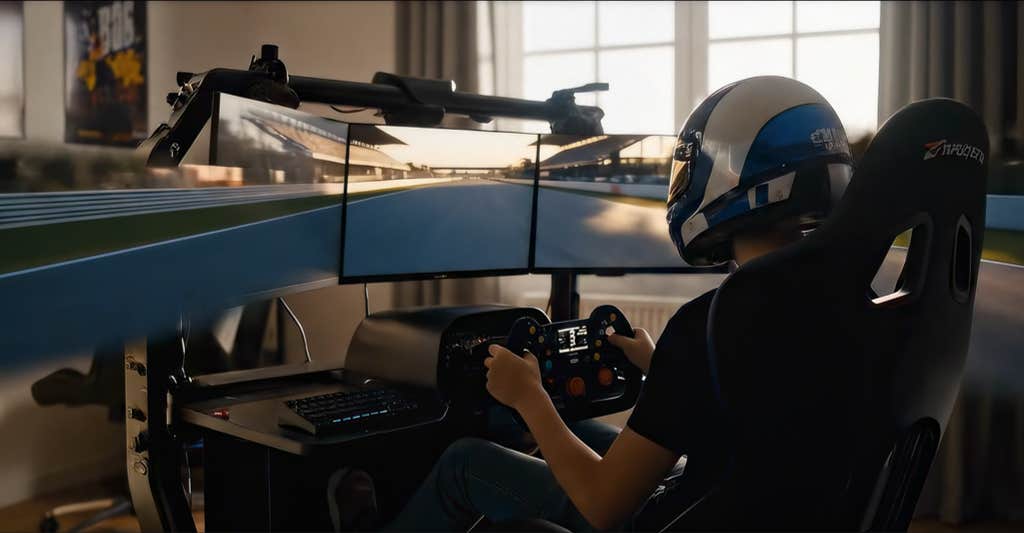
"Imagine yourself in a racing rig at home. You pay for a ticket to enter the live race and you're sitting on the grid in your car. Racing sim videogames are already almost photo-realistic. The cars and environments behave exactly like real race conditions. But now, you're actually sitting in the live race with all the uncertainty, excitement and drama that brings."Kristien Wendt, CEO & Co-Founder, Real-E-Racing Ltd
Why Real-E-Racing Chose RTKdata
RER evaluated several correction providers before choosing RTKdata. The decision came down to two things: does the technology deliver, and does the partner understand what we're trying to build?
"We've trialled a few different providers, but we had a great chat in our meeting and felt there's really good alignment between our organisations. We felt the support and excitement about what we're achieving. We're also confident RTKdata can provide technically what we need after testing."John Cleasby, CTO & Co-Founder, Real-E-Racing Ltd
The Results: From Silverstone POC to a Full Beta Season
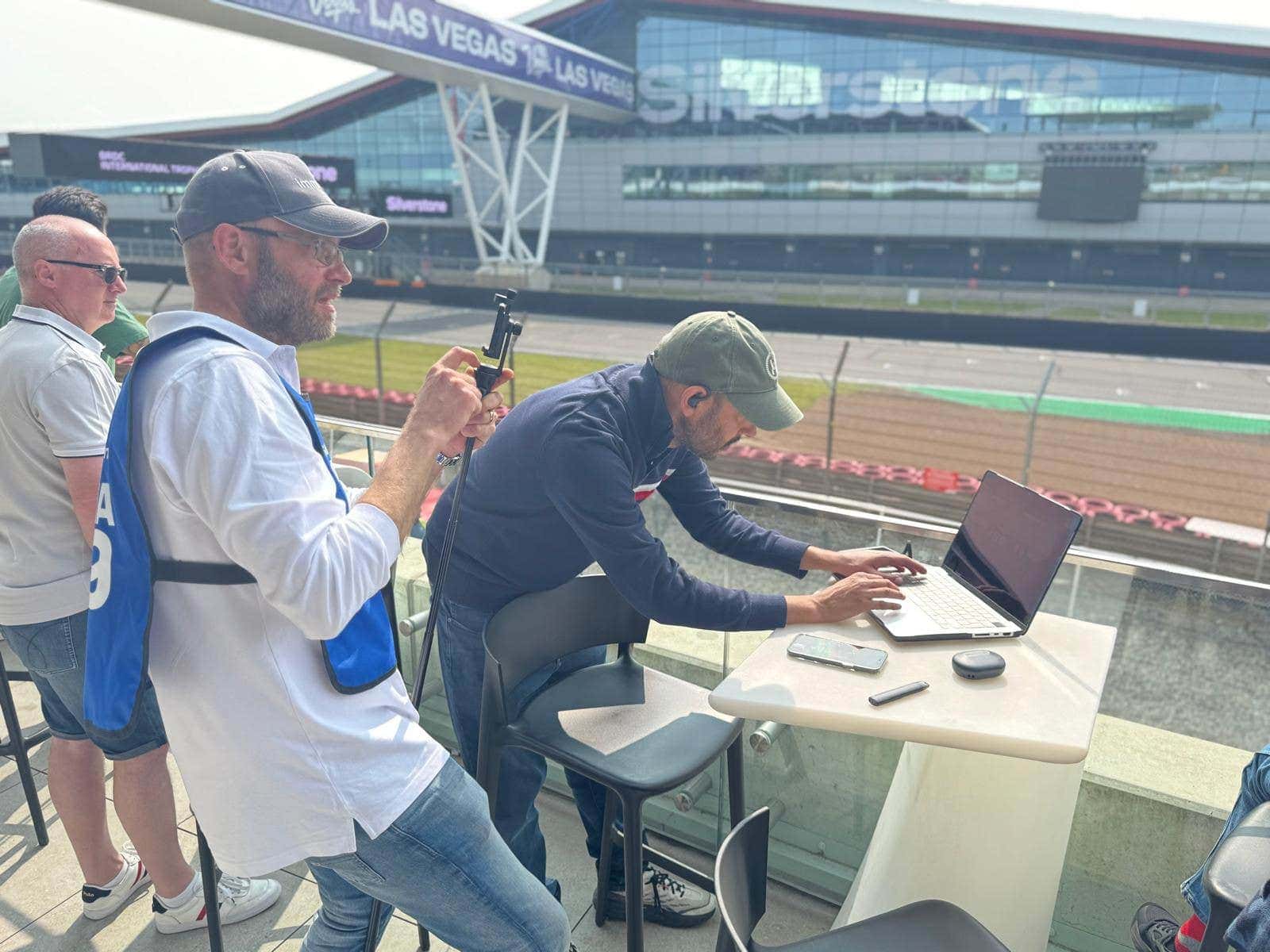
Real-E-Racing's end-to-end pipeline was validated in May 2025 with a 1,000+ km live stream from Silverstone to Stuttgart. By April 2026 the company had won a Scottish EDGE regional award and was running live RTKdata NTRIP corrections across real race weekends, ahead of a public Steam beta in October 2026.
| Milestone | Status | Detail |
|---|---|---|
| Silverstone proof of concept | Complete · May 2025 | Live race car streamed Silverstone → Stuttgart (1,000+ km) into sim racing rig |
| Scottish EDGE award | Won · April 2026 | South of Scotland Regional Finals8 |
| Live RTKdata NTRIP corrections | Active · April 2026 | Centimeter-accurate positioning during real race weekends |
| 2026 season deployment | Active | 5 European circuits, aligned with Polo Cup Germany rounds |
| Public Steam live beta | Scheduled · October 2026 | Hockenheimring final weekend |
| Racing series commercial pilots | Planned · 2027 | Direct partnerships with series owners |
2026 Real-World Testing Calendar
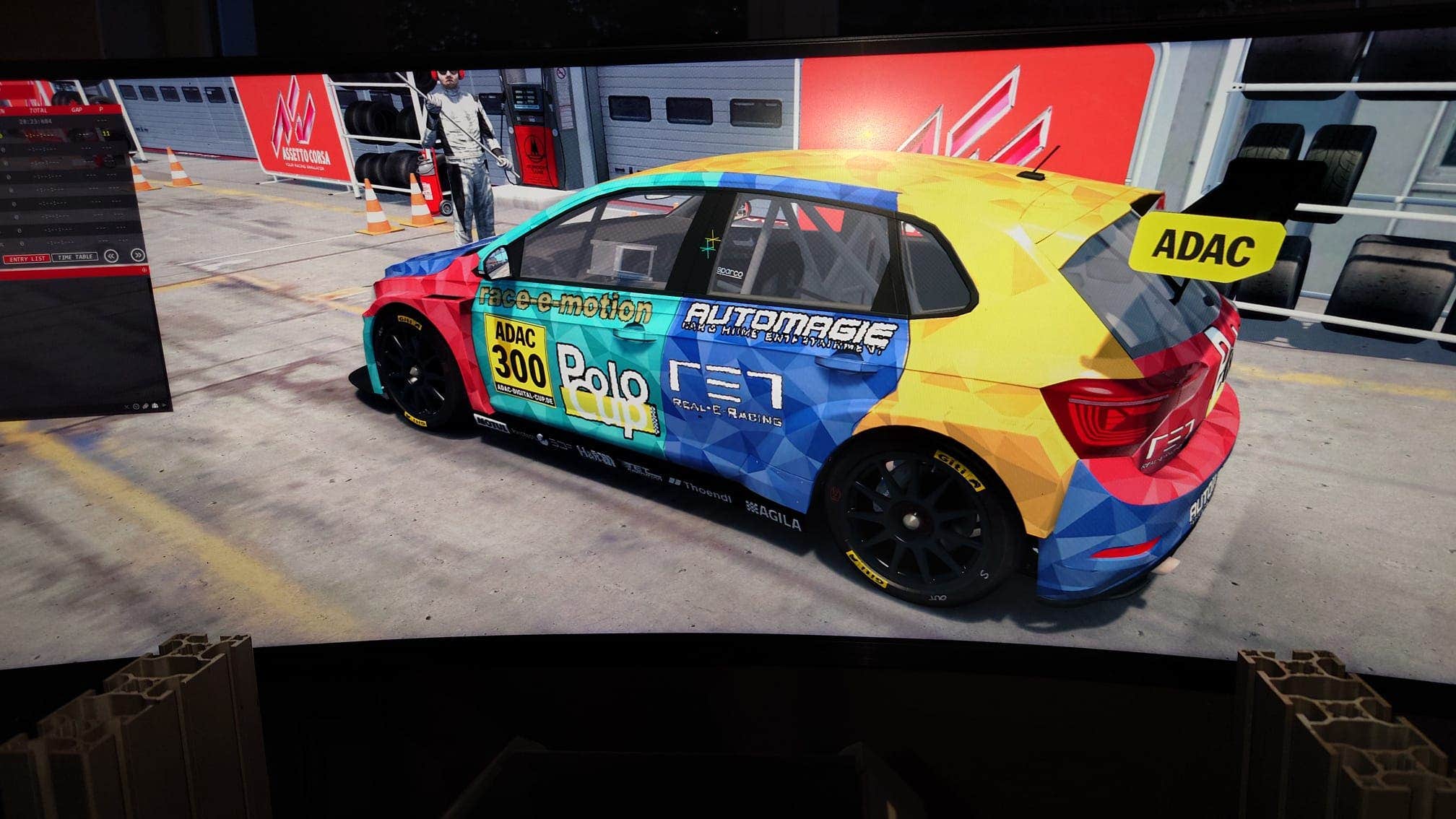
Real-E-Racing is running end-to-end live digital twin testing across five European circuits in 2026, aligned with the inaugural Polo Cup Germany season (MARACO Management and Volkswagen Motorsport South Africa, racing the 300 HP Volkswagen Polo GTI Cup).9 The deployment schedule:
| Round | Circuit & Dates | Races |
|---|---|---|
| 1 | Motorsport Arena Oschersleben · 24-26 April 2026 | Races 1 & 2 |
| 2 | Nürburgring · 29-31 May 2026 | Races 3 & 4 |
| 3 | Circuit Zolder, Belgium · 10-12 July 2026 | Races 5, 6 & 7 |
| 4 | DEKRA Lausitzring · 25-27 September 2026 | Races 8, 9 & 10 |
| 5 | Hockenheimring · 24-25 October 2026 · Public Steam Beta | Races 11 & 12 |
What Real-E-Racing Says About RTKdata
"Early days right now for us, but I would definitely tell another team considering RTK positioning that it was super easy to get set up and use, and the people we've chatted to have been brilliant."John Cleasby · CTO & Co-Founder, Real-E-Racing Ltd
The Vision: Beyond Motorsport
Real-E-Racing's live digital twin proves that centimeter RTK is ready for precision vehicle tracking at race pace - the accuracy and latency requirements exceed most production automotive applications.
Motorsport is the beachhead. Real-E-Racing's ambition extends to any live event where physical position, movement and timing matter, and where an audience would pay to participate instead of just watch. CEO Kristien Wendt frames it as becoming "the 'Dolby' of live events within interactive 3D environments."
The same technical foundation applies: centimeter-accurate RTK positioning, low-latency synchronization, live digital twin rendering, interactive 3D. Real-E-Racing is building the infrastructure layer for a category that barely exists yet.
Technical Setup
| Component | Detail |
|---|---|
| GNSS Receiver | Multi-band, multi-constellation, RTCM 3.2 compatible |
| Correction Service | RTKdata NTRIP RTK |
| Correction Format | RTCM 3.2 MSM |
| Constellations | GPS · GLONASS · Galileo · BeiDou |
| Horizontal Accuracy | 1-2 cm (RTK fix) |
| Position Update Rate | up to 20 Hz |
| Vehicle Data Sync | IMU + CAN telemetry, time-aligned to GNSS atomic-clock timestamps |
| End-to-End Latency Target | < 100 ms relative between cars |
| Connectivity | Cellular NTRIP client (no physical base station required) |
| Delivery | Live digital twin stream into sim racing game environment |
What's Next
Success for the October public Steam beta is measured in two dimensions: technical validation at scale and commercial demand signal. Real-E-Racing is aiming for thousands of players across the season tail to generate the metrics, insights and feedback needed to scale.
The long-term roadmap: racing-series pilots across multiple championships, and direct partnerships with the organizations that own the IP and broadcast rights. Further out, the vision extends beyond motorsport into any live event where physical position, timing and interactivity define the experience.
Centimeter-accurate live positioning is the foundation everything else is built on. Point One Navigation currently supplies RTK to autonomous racing (the Indy Autonomous Challenge),10 but no one else is streaming RTK-accurate live race data into sim racing for human players. Real-E-Racing is the first, and RTKdata's NTRIP network is the correction backbone that makes it possible.
Frequently Asked Questions
Why does motorsport need RTK GPS instead of standard OEM telemetry?
Standard motorsport telemetry GPS (such as MoTeC GPS-L10 at roughly 2.5 meters CEP accuracy and 10 Hz update rate, or Bosch Motorsport GPS modules designed primarily for lap triggering) is built for broadcast overlays and lap timing, not for placing a car inside a photo-realistic sim racing game. At 200+ km/h, a 10-20 cm error breaks the illusion: collisions look wrong, wheel-on-surface contact drifts, close-quarters racing feels disconnected. RTK corrections via NTRIP bring horizontal accuracy to 1-2 cm. That is a 50 to 250 times improvement over OEM motorsport GPS.
What is a live motorsport digital twin, and how does Real-E-Racing build one?
A live motorsport digital twin is a virtual replica of a physical race that updates in real time from the actual cars on track. Real-E-Racing captures centimeter-accurate RTK GPS positions from race cars, synchronizes them with vehicle telemetry (IMU, CAN bus, steering, throttle, brake), and streams the unified feed into a sim racing game. Fans at home in a racing rig can then join the live race, sitting on the grid alongside real drivers, with the virtual environment mirroring the physical track state moment by moment.
What accuracy does MoTeC or Bosch Motorsport GPS provide, and why isn't it enough?
MoTeC's GPS-L10 logger GPS operates at 10 Hz with typical consumer-grade GNSS accuracy around 2.5 meters CEP. Bosch Motorsport's GPS modules, integrated into the DDU 9 and DDU 10 dash loggers, are designed primarily as a lap trigger for pre-dated lap times rather than high-precision positioning. Neither manufacturer offers RTK as a standard motorsport product. This is fine for lap overlays on TV broadcasts but nowhere near precise enough to place a virtual car correctly inside a sim racing game at racing speeds.
How critical is latency for a live racing digital twin?
Latency is everything. Some natural delay from track to game is unavoidable when syncing across geographies, but relative timing between cars has to be tight. An extra 100 milliseconds at racing speed completely changes how a collision looks and feels. That's the difference between a realistic, playable experience and a broken one.
What RTKdata service does Real-E-Racing use, and why did they choose it?
Real-E-Racing uses RTKdata's NTRIP RTK correction service, delivered in real time via cellular connectivity, with no physical base station required. They trialled several providers before choosing RTKdata, citing technical fit, easy NTRIP profile setup, and strong alignment between the two teams on the goal of bringing centimeter-accurate live positioning to motorsport entertainment.
What is Race Data as a Service (RDaaS)?
Race Data as a Service (RDaaS) is Real-E-Racing's category definition: a live data pipeline that transforms real-world motorsport data into interactive digital experiences racing series can monetize across sim racing games, spectator engagement, sponsorship activations, esports and driver training. The backbone of RDaaS is centimeter-accurate RTK positioning; without it, the virtual experience cannot faithfully mirror the physical race.
Where and when was the Real-E-Racing proof of concept tested?
Real-E-Racing's proof of concept ran at Silverstone in May 2025. The team streamed a live race car from Silverstone to Stuttgart, a distance of over 1,000 km, into a sim racing rig, validating the end-to-end pipeline. Real-E-Racing describes this as the moment "we made Real-E-Racing REAL."
Sources & Citations
- SportsPro / Nielsen Sports: F1 global fanbase & TV viewership, March 2025
- Formula 1 Corporate: F1 & Motorsport Network 2025 Global Fan Survey
- SportBusiness Tech: Sport's drive for Gen Z and Alpha, February 2026
- SpeedWeek: DTM viewer figures on ProSieben, 2023
- Esports Charts: 2025 F1 Sim Racing World Championship viewership
- MoTeC GPS-L10 User Manual
- Bosch Motorsport DDU 10 Datasheet (PDF)
- The Scotsman: Scottish EDGE 20 high-growth regional businesses, 2026
- Polo Cup Germany: official series site
- Point One Navigation: IAC Autonomous Racing RTK
- Mordor Intelligence: Racing Simulator Market
- BoxThisLap: iRacing breaks 300,000 simultaneous users (January 2025)