
RTK for Robotics:
Achieve 1-2 cm Accuracy

RTK for robotics uses Real-Time Kinematic GNSS corrections to achieve 1-2 cm positioning accuracy on autonomous robots, AGVs, and mobile platforms. RTKdata streams NTRIP corrections from 20,000+ base stations in 140+ countries for ROS-based systems, ArduPilot vehicles, and custom builds, no base station hardware required.

Start your free trial

No Credit Card 30 Days Free Best RTK Coverage

What Is RTK for Robotics?

RTK for robotics uses correction data from a network of reference stations to reduce a robot’s GNSS error from metres to 1-2 cm in real time. The robot’s receiver connects over NTRIP through its onboard computer or a cellular modem, so no local base station is installed on site. RTKdata streams corrections via the standard NTRIP protocol. Plans start at $40/month.

How to Set Up RTK on a Robot in 3 Steps

From signup to centimeter-accurate robot navigation. No base station purchase, no complex setup.

01

Choose a Plan

Sign up at rtkdata.com in under 2 minutes. No credit card required. Instant access to NTRIP credentials.

02

Enter NTRIP Credentials

Mount your RTK receiver on the robot, wire it to your onboard computer, and configure your NTRIP client with RTKdata credentials.

03

Verify FIX

Once RTK FIX is achieved, the receiver outputs centimeter-accurate positions at up to 20 Hz.

Robotics GNSS Corrections Without a Base Station

Get your NTRIP credentials in under 2 minutes. Deploy with confidence today.

RTK Corrections for Robot Fleets

One Stream per Robot

A robot fleet needs one RTKdata data stream for each robot that is connected at the same time, because one set of NTRIP credentials allows one connection at a time.

Scale with One Contract

Roll out corrections to dozens or hundreds of robots with one contract. Volume licensing covers multiple devices, so your fleet can grow without separate agreements.

Add Streams Anytime

Add or remove data streams at any time from your account dashboard. An extra stream is active immediately, so you can add one on the day of a job and remove it later.
For larger fleets, we set up a volume rate, one account, and invoice or PO billing. Share your fleet size and hardware, and we prepare your quote.
For individual robots, see our RTK subscription plans.

Why Use RTK GPS for Robotics?

From RTK autonomous navigation to precision agriculture robots, RTK positioning unlocks reliable outdoor automation.

RTK Autonomous Navigation & Path Planning

Standard GPS drifts 1-3 meters, making lane-keeping unreliable. RTK reduces error to 1-2 cm, enabling robots to follow predefined paths, execute precise turns, and return to exact coordinates.

Agricultural Robotics & Weeding

Precision weeding robots need centimeter resolution. RTK-guided agricultural robots stay centered in the row, reducing herbicide use by up to 90%.

RTK AGV Navigation for Warehouse & Logistics

Outdoor logistics AGVs transport materials between buildings, loading docks, and storage yards. RTK provides reliable positioning in open-air environments where indoor-only solutions fail.

Research & Development

Universities and research labs use RTK GPS as ground truth for sensor fusion, SLAM validation, and autonomous vehicle testing. RTKdata provides affordable centimeter positioning for prototyping without enterprise contracts.

Compatible Hardware for RTK Robotics

GNSS Receivers for Robotics

Receiver Best For Setup Guide
ArduSimple simpleRTK2B ArduPilot & ROS prototyping, plug-and-play Setup Guide →
Septentrio mosaic-X5 Production robots, multi-constellation, AIM+ Setup Guide →
u-blox ZED-F9P RTK ROS builds, wide community support Setup Guide →
SparkFun RTK Express / Facet Quick evaluation, built-in display & Wi-Fi NTRIP Setup Guide →

Robot Platforms & Autopilots

Platform NTRIP Integration Notes
ROS / ROS 2 ntrip_client + ublox_gps nodes Publishes NavSatFix with RTK status
ArduPilot (Rover / Boat) Built-in NTRIP client F9P via GPS port, auto-inject corrections
PX4 Autopilot MAVLink GPS inject Pixhawk and derivatives
Custom Linux (RPi, Jetson) str2str / RTKLIB / gpsd Works with any SBC

NTRIP Client Software

Software Use Case Notes
str2str (RTKLIB) Lightweight CLI NTRIP client Pipes corrections to serial/USB
ntrip_client (ROS pkg) Standard ROS NTRIP package Publishes RTCM to receiver
Hardware-agnostic: RTKdata works with any GNSS receiver that speaks NTRIP, from a $200 F9P board on a Raspberry Pi to a $2,000 Septentrio module on a production AGV. Check coverage in your area →

RTK for Robotic Mowers

If you build or integrate a robotic mower, stream RTK corrections to its receiver over NTRIP instead of installing a base station on every site. Test fix stability on real sites before you scale, and plan what the mower does when the fix drops: continue with reduced accuracy, slow down, rely on vision or IMU, pause, or return to the dock. Our robot mower RTK accuracy guide covers fix and float, multipath hotspots and boundary mapping.
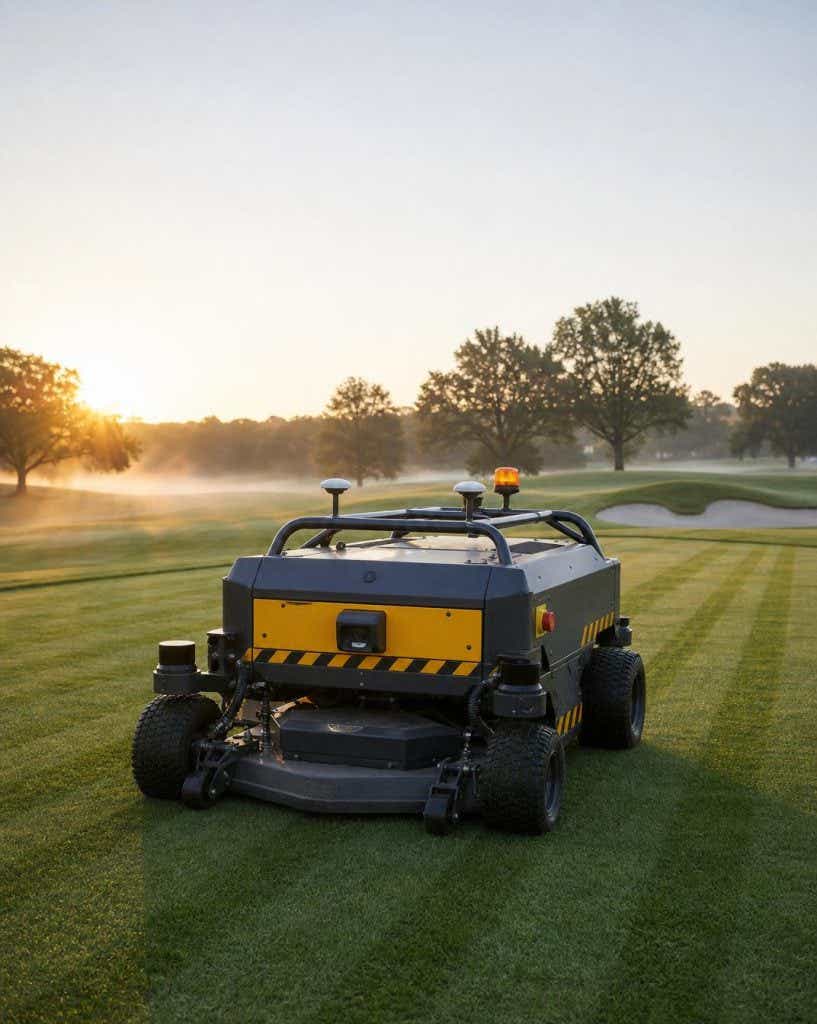
Autonomous robotic mower with RTK GNSS antennas on a striped golf course fairway at sunrise

RTK and Sensor Fusion: GNSS/INS for Outdoor Robots

The Localization Stack

On an outdoor robot, RTK is one input to the localization stack, not the whole stack. RTK GNSS supplies an absolute global reference that odometry can’t provide, and it also ties SLAM maps to real-world coordinates. In a GNSS/INS stack, the IMU predicts fast motion, and an RTK update then corrects position when it is available and passes a consistency check.

FLOAT, FIX and Fallbacks

At RTK FLOAT, the receiver is getting corrections but has not yet resolved the carrier-phase ambiguities, so accuracy is lower and varies by receiver. Receivers converge from Autonomous to FLOAT to FIX, and reflections or blockage can take a fix away. A robust stack gates RTK updates on fix status and falls back to inertial or SLAM estimates when the fix drops.

Indoors, SLAM and UWB

RTK needs a clear view of the sky and will never work indoors. At the building entrance, the robot’s stack hands over to LiDAR SLAM, or to UWB, which gives absolute ranging indoors but needs installed and surveyed anchors. SLAM is not the same as sensor fusion: SLAM builds a map and localizes in it, while RTK keeps that map tied to real-world coordinates outdoors.
Our guide to GNSS and IMU sensor fusion for robots compares EKF, UKF, particle filters and factor graphs and walks through a ROS 2 localization stack.

GNSS RTK for Autonomous Robotics

RTKdata provides open-standard NTRIP corrections for AGVs, UGVs, robotic mowers, and autonomous platforms, delivering centimeter-level positioning for navigation, geofencing, and repeatable routes. Integrate RTK directly into your autonomy stack without the complexity of managing local base infrastructure.

What Robotics Engineers Say About RTKdata

⭐ 4.9 from 47 Google Reviews

Case study

BASTIDOR: Unitree Go2 Robot Dogs and Drones on One RTK Reference

BASTIDOR, an Ontario company, is building a construction documentation platform that records firestop penetrations with Unitree Go2 robot dogs, drones and NFC tags. Each robot and drone takes RTKdata’s NTRIP corrections from the nearest reference station, so outdoor ground and aerial captures share one coordinate space. There is no base station to set up, move or guard.

Read the BASTIDOR case study

“While developing a navigation system, I needed to evaluate RTK aiding and was referred to RTKdata company. I requested a 30-day trial through their website and received access within an hour. Excellent service and outstanding support.”
John Bergstrom, PAGM LLC
“RTKdata has become an essential part of our geospatial workflows. The precision and reliability of their correction data allow us to deliver results our clients trust, every time. Setup was straightforward, coverage is excellent.”
Thomas Cargill, Lone Star Geospatial LLC
“Reliable service within their listed coverage areas, and really appreciate their excellent customer service as well. They offer quick responses and helped us adapt the invoicing process to our company’s needs.”
Laura Silva, Exactus Energy

Frequently Asked Questions

What is RTK robotics and why does it matter for autonomous navigation?
RTK robotics uses Real-Time Kinematic GNSS positioning to give robots centimeter-accurate outdoor location data. RTK corrections from RTKdata reduce positioning error to 1-2 cm, enabling reliable autonomous navigation without relying solely on expensive LiDAR or vision systems.
Yes. Connect an RTK GNSS receiver via USB, run an NTRIP client node to stream corrections from RTKdata, and publish the corrected position via standard NavSatFix messages. Popular RTK ROS packages include ntrip_client and ublox_gps.
RTK requires a clear view of GNSS satellites, so it works best outdoors or in semi-open environments like loading docks. Many logistics robots use RTK for outdoor yard navigation and switch to UWB or LiDAR SLAM when entering a building. Around loading docks, signals reflected off buildings or metal cause multipath; our maritime article on RTK multipath and sensor fusion shows how tightly coupled GNSS/INS bridges dropouts and smooths multipath.
With a stable RTK FIX, expect 1-2 cm horizontal accuracy and 2-3 cm vertical accuracy. This precision is sufficient for row-following, precise docking, and repeatable path execution.
RTKdata NTRIP corrections typically arrive within 100-300 ms over 4G/LTE, and the receiver computes positions at up to 20 Hz. For most outdoor robot applications this latency is well within acceptable limits for real-time path following.
The most popular receivers are the u-blox ZED-F9P (affordable, widely supported in ROS), Septentrio mosaic-X5 (multi-constellation, high reliability), and ArduSimple simpleRTK2B (plug-and-play with ArduPilot). All accept NTRIP corrections from RTKdata.
Standard GPS provides 1-3 meter accuracy, causing path drift and missed waypoints. RTK uses correction data from a nearby reference station to reduce errors to 1-2 cm, keeping your robot centered within centimeters on any predefined path.

Start Your Robotics RTK Corrections Trial

Get centimeter-accurate outdoor positioning for your robot in under 15 minutes. 20,000+ base stations, 140+ countries. No hardware to buy.